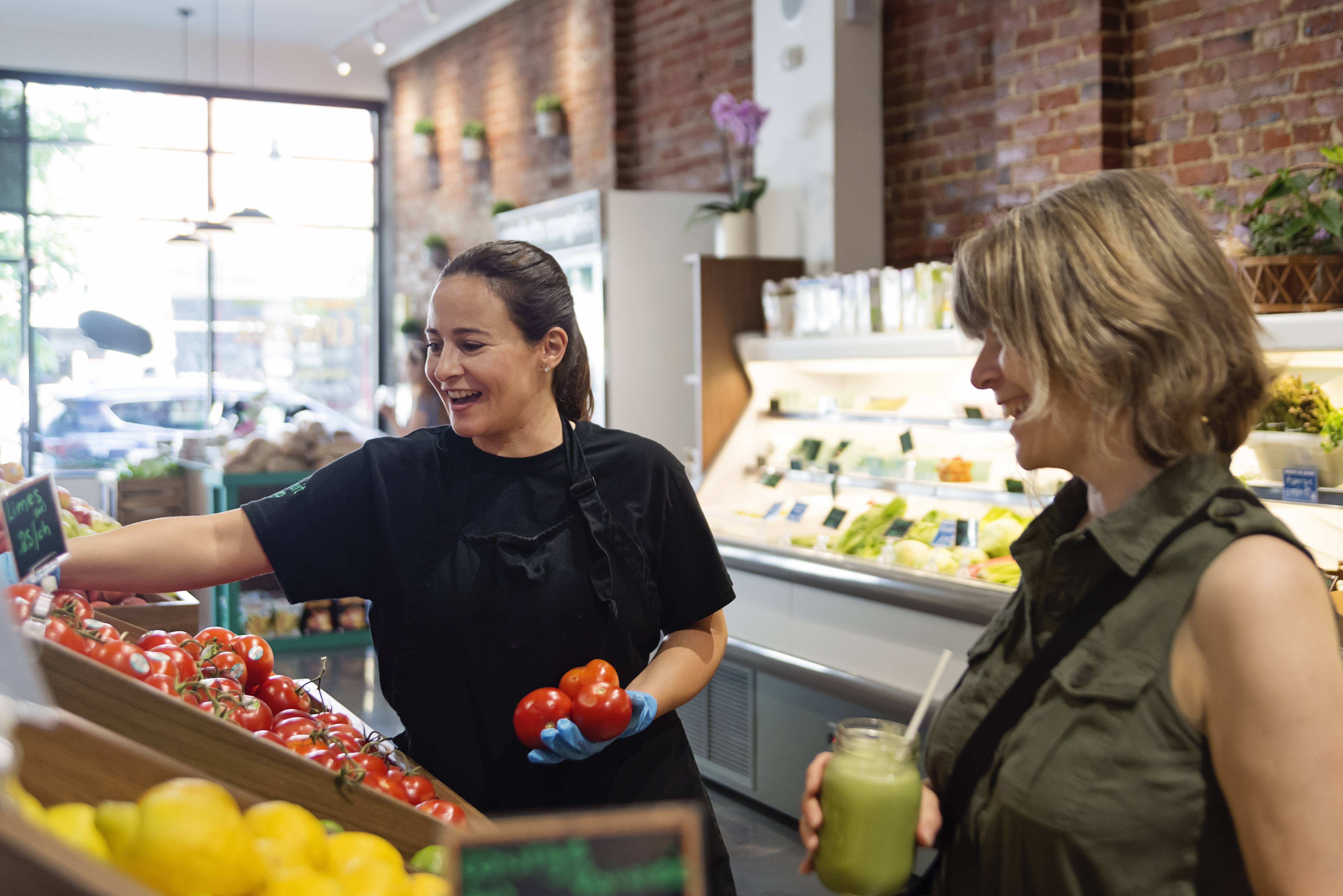
When we think about transforming our food system, conversations often focus on global supply chains, imported produce, and multinational corporations. But real change—change that strengthens communities, regenerates ecosystems, and improves health—often starts much closer to home. At the heart of this transformation is the local food economy.
A local food economy is a food system rooted in place, where production and consumption are connected geographically and relationally to strengthen community resilience and create equitable, shared prosperity. In practice, this means food that is grown, processed, and sold within a region, linking farmers, entrepreneurs, and residents in a web of exchange that circulates economic, social, and ecological value locally.
Economic benefits: keeping wealth where it’s grown
Money spent locally tends to stay local. Independent food businesses reinvest in their employees, source from nearby suppliers, and strengthen the region’s overall economy.
Beyond direct profit, local enterprises build stronger supply relationships, more resilient regional markets, and often represent a greater diversity of opportunities, qualities that cushion communities from external shocks.
Environmental benefits: regeneration through place-based systems
Local food economies are dynamic systems that are oriented in service of life. A system that prioritizes the regenerative capacity of a landscape sees each stage of the supply chain as an opportunity.
A global network of locally regenerative food economies shifts our relationship to trade: food moves between regions that are each cultivating their own regenerative capacity. Coffee, grains, or produce are still exchanged, but ideally between food economies that are restoring, rather than degrading, their landscapes.
Within this broader system, shorter supply chains and seasonal consumption still play an important role. Reducing reliance on energy-intensive storage, transport, and inputs can lower emissions and resource use. But these are reinforcing benefits, not the primary goal.
The deeper impact is structural. By strengthening regional production and aligning it with ecological restoration, local food economies help keep farmland in active, regenerative use, reduce pressure to convert natural habitats, and embed food systems within the long-term health of the landscapes they inhabit.
What defines a “local” food system is not distance alone, but whether production actively restores the ecosystems it depends on.
Health benefits: nutrition from the soil up
Because local food economies are rooted in care for the land, they also nurture human well-being. Research on “health per acre” argues that nutrient yield, more so than crop yield, should measure agricultural success. Industrial agriculture, with its heavy chemical inputs, produces significantly less nutrition per hectare than ecologically grown food.
As shown in Navdanya International’s report Health per Acre, regenerative methods create more nutrient-dense crops while restoring soil fertility and microbial richness. A food system that values soil as a living community, not an input surface, inevitably produces healthier people and ecosystems.
Community resilience: food as a social good
Local food economies are relational as much as economic. Community-supported agriculture programs, local food hubs, farmers’ markets and regional supply chains reclaim food as a connector, linking people to place, neighbours and tradition.
Research consistently shows that communities with higher proportions of locally owned businesses have stronger social capital, civic engagement, and overall well-being. Locally rooted enterprises act as anchors, building trust and mutual commitment that endure through economic shocks or disruptions. When crises arise, from climate-related floods to supply chain breakdowns, local businesses respond faster, adapting and reopening more readily. By contrast, regions dominated by absentee-owned corporations often experience declines in civic life and public health.
From local to landscape: activating whole-system regeneration
There is growing international recognition that local food economies are part of a larger story, one in which food systems are organized around bioregions, watersheds, soils, and ecosystems, and the cultural knowledge of the communities that live within them. Food moves from merely a commodity to a social good. It becomes a pathway for restoring landscapes, strengthening local livelihoods, and renewing the relationship between people and place.
Regen10 and 1000 Landscapes for 1 Billion People emphasize this view of the food system as a potent vehicle for large-scale ecological renewal. Their strategy is clear: meaningful change must go beyond farm fences and food value chains. It must also protect the natural systems, cultural heritage, and community relationships that sustain life in a place.
A key insight from this work is the importance of community-led landscape partnerships. These partnerships create a neutral, trusted space where farmers, Indigenous communities, local governments, businesses, civil society and funders can work together over the long term to plan and implement regenerative change across a landscape. They are the social architecture for landscape regeneration, enabling the alignment of ecological restoration, local livelihoods, and place-based investment.
In Canada, several place-based social impact funds already reflect this thinking:
Reminding us that these are more than just economic levers, Commonland’s four holistic returns offer a useful framework. Investment in local landscape restoration can generate inspiration, social capital, natural capital, and financial capital, creating value for ecosystems, communities and economies. Landscape partnerships are the process, the four returns are the outcomes: inspiration builds shared purpose, social capital strengthens trust and collaboration, natural capital restores soils, water and biodiversity, and financial capital helps sustain the work over time.
Local food economies offer a practical and powerful way to rebuild resilience, keep wealth circulating in communities, restore ecosystems, and improve well-being. This is the horizon of the work: building locally rooted, relationally based food webs where demand for local food that nurtures both people and planet helps catalyze the regeneration of whole landscapes.