

In this second article in our series ‘Sizing, Influencing and Growing the market’ the big question is how do you influence your target market to buy more foods that are locally, organically and regeneratively grown?
By identifying the segments in the Canadian population with the top potential it makes it much more possible to strategically target them and position local food as a better choice based on what the different target segments care about most.
As described in article one, a segment with great potential is OneEarth Living’s Sustainable Living Motivation1“Eco-Trends”. We like to think of it as the “low hanging fruit”. The Eco-Trends segment represents a significant percentage of Canadians who are motivated to reduce their environmental impact and make a difference through what they buy ( ~15-20% of the population based on various OneEarth Living studies). They have an outsized impact because they share widely about their choices with their networks by word of mouth and on social media.
But there’s a catch: they don’t want to make changes alone.They need to feel like others are doing it too, and that their choices are part of something bigger.
This need provides a powerful opportunity. In her book ‘Leave the Lights On’, Dr. Jiaying Zhao, Professor of Psychology and Sustainability at the University of British Columbia (UBC) outlines how individual, joyful behavioral modifications (in travel, food, and shopping) can cascade into systemic cultural change2. In a recent LinkedIn post at NY Climate week, she describes prominent sociological research (notably a famous 2018 study from the University of Pennsylvania published in Science) that shows once a committed minority reaches roughly 25% of a population, they successfully overturn established social norms to shift the whole group.
To imagine how this works, think about the rise of secondhand shopping and thrifting. In previous research by OneEarth Living, a young person in Vancouver who had recently moved from Sweden described how he only started buying secondhand in Vancouver, Canada because “it's very cool here, and it's very good”. What he likely meant by cool was that it was ‘the thing to do’. According to a Habitat for Humanity study in 2026 “two-thirds (66%) of Canadians agree thrifting is now part of mainstream shopping culture.”3
We aren’t there yet for local, organic, regenerative food. This is where positioning comes in.
Job number one is signalling that local, organic and regenerative food is a choice that others are increasingly and joyfully taking part in. Instead of focusing on the customer journey (for global, conventional food) that concludes in a solo decision making moment in a lonely grocery store aisle, the unique opportunity for local, organic and regenerative food is in a customer journey that includes joyful in person experiences with others like them.
Job number two in positioning is framing vs. other alternatives. Local, organic and regenerative food is of value to Eco-Trends…but they don’t always understand the difference that makes a local, organic and or regenerative apple different from a conventional one.
So how much do people need to know?
Eco-Trends need to be engaged with simple, feel good messages they can easily share with their networks. (We have volumes of research at the ready to support that farmers who support nature and focus on soil health provide us health and environmental benefits but this group is likely not going to ask for it.)
It can be tempting to explain everything: soil health, biodiversity, farming practices and the resulting nutrition and environmental benefits. But strategy and advertising industry veteran David Williams makes the case for simplicity. ” People will confidently tell you all sorts of things about what makes an SUV safe, what makes a whisky higher quality, why they're paying six dollars for their coffee, why they're having a protein shake for breakfast etc. If you pressed them on any of those things their knowledge base would often be shakier than they'd like to admit.” David encourages this… “What’s important is the simplicity of a story.”
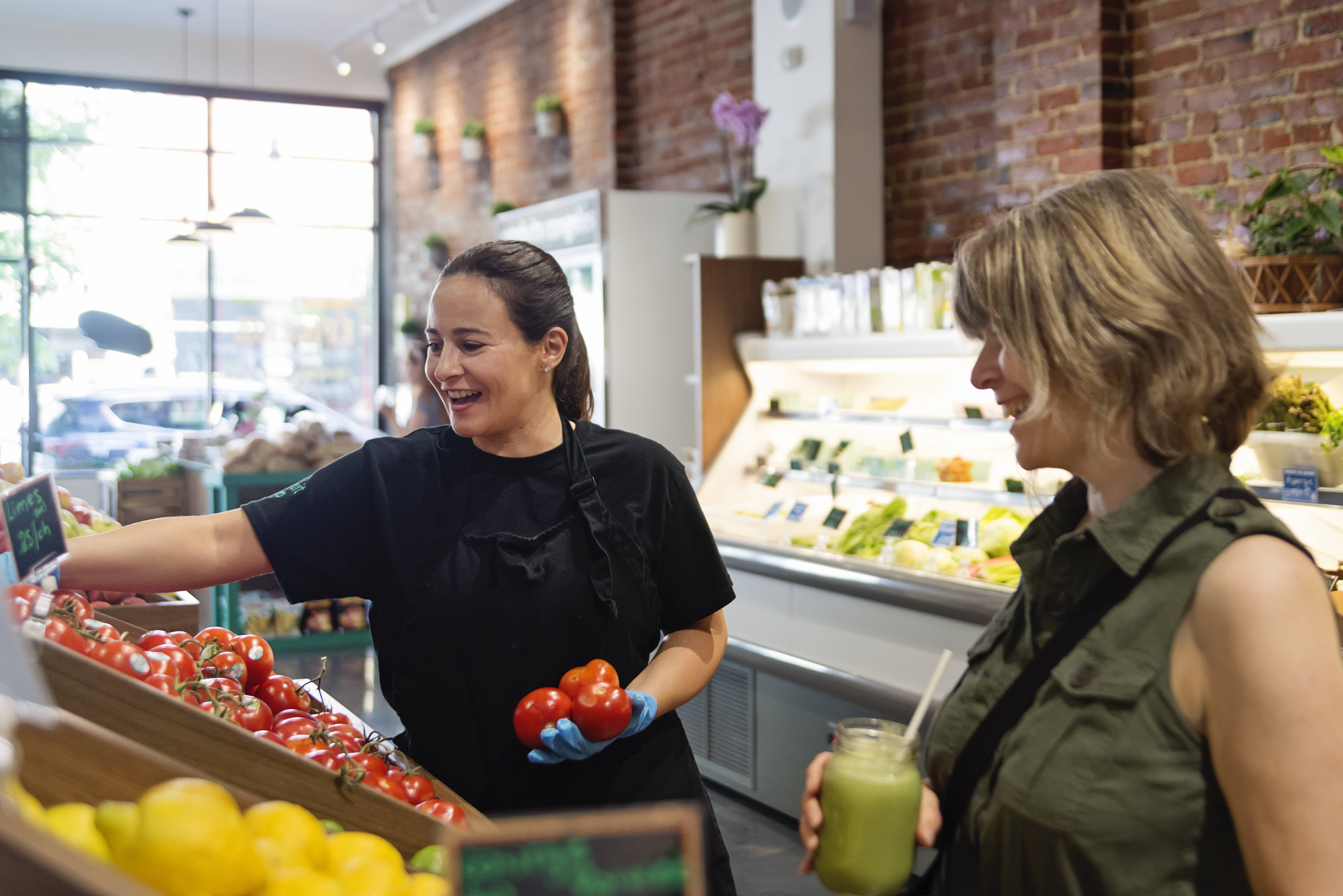
“ Hello, do you want to try a yellow taxi tomato?” We think of the most crucial part of the customer journey as starting there, with a joyful taste experience, and the learning about the difference vs. conventional foods (beyond the exceptional taste) is what follows and occurs over time as a result of curiosity sparked by the taste and social experience.
You might be thinking…this is nothing new. Food sampling is a standard tactic. But think about what you are most often invited to taste. And where. It’s often a big box store …and what’s on offer is ultra-processed food. Leading with taste is much less common for local, organic and regenerative whole foods. It’s a strategic imperative for influencing Eco-Trends.
For the CCFE, this meant creating a new brand to really engage this target - Flavour Harvest.
The brand itself is overtly joyful - in its colours and tone of voice. It showcases the vibrant diversity of local produce and how diverse cuisines make it sing. It's not just about food buying choices - it’s an invitation to join a culture that celebrates local food and seasonal eating.
Flavour Harvest positioning is:
- Social: activated in collaboration with partners that invite their communities to in-person social experiences with farmers and chefs from diverse communities
- Feel good: An invitation to TASTE local, regenerative, organic food
- Simple: connecting exceptional, vibrant, complex flavours with the local farmers who grew them.
The longer-term learning objective? What makes this carrot taste so good is the healthy soil it is grown in.
With a defined segment, target and brand positioning, the path to influencing the market starts to become clearer. We can also apply behavioural science to specifically influence Eco-Trends and nudge their choices through marketing activations and programs.
Introducing SHIFT
SHIFT is a literature review and behavioural science framework by Dr. Katherine White and Rishad Habib4. It draws on more than 400 published scientific sources in marketing, psychology and economics on encouraging ecologically sustainable consumer behaviours.
The framework identifies five factors that encourage sustainable behaviour change:
Social Influence
Habit Formation
Individual Self
Feelings and Cognition
Tangibility
Three of these are particularly relevant when thinking about how to engage Eco-Trends: Social Influence, Habit Formation and Tangibility.
Social Influence is the biggest, often overlooked driver of behaviour change
We are all innately social creatures. With existing data from our market segmentation in hand, we knew the Eco-Trends segment is particularly likely to be influenced by those in their networks - in person and online.
Farmers’ markets offer a natural opportunity to activate this social influence. Destination experiences can bring people together around taste, offer conversation and discovery, while social media can amplify those experiences beyond the market.
The SHIFT framework also recommends leveraging social norms by asking “block leaders” to persuade others to engage in sustainable behaviours.
This can mean identifying trusted people who already have influence within a community and inviting them to bring others along. The goal is not telling people what to do, but rather making a new behaviour visible as the “thing to do”.
Habit Formation
Habit formation requires new choices to be easy. As the SHIFT report notes, behaviour that requires high levels of mental processing is unlikely to become a habit.
One way to reduce that mental load is to focus on shifting one familiar, relatively low-cost food choice first.
Once one sustainable habit is established, people may be more likely to make additional changes. The opportunity is to make the first step simple enough that people can actually take it.
Tangibility
Benefits (or harms) of food choices on nature and the environment can be really intangible and feel really far away. “Environmental appeals often ask people to engage in behaviours that have consequences that are far off [or] in the future.” SHIFT report 2018
Taste can make those benefits more tangible.
A delicious sample or joyful taste test gives people something immediate to experience. Flavour becomes a form of feedback: a vibrant, flavourful food can create a tangible connection between the eater, the farmers, and the thriving ecology in which that food was grown.
This is the opportunity for local, organic, and regenerative food: start with something people can see, taste and share, and then with simple storytelling, give them reasons to become curious about what is behind that experience.
So in sum, to influence the market, marketing strategy and behavioural science can work together. A strategic target, clear positioning, and an understanding of the behavioural factors that shape sustainable choices can help move local, organic and regenerative food from something people value in theory to something they actively choose.
If you are keen to learn more on this topic including near-future forces that are likely to open up new opportunities, you’ll want to look out for our third article in this series…’Growing the market for local, organic and regenerative food’
Sources:
1. OneEarth Living, Motivations for Sustainability Living
2. Psych UBC News, article Leave the Lights On 2026
3. Bloomberg News, article The Thrift Shift 2026
4. Sitra, article SHIFT 2018
5. White, K., Habib, R., & Hardisty, D. J. (2019). How to SHIFT Consumer Behaviors to be More Sustainable: A Literature Review and Guiding Framework. Journal of Marketing, 83(3), 22-49. https://doi.org/10.1177/0022242919825649


