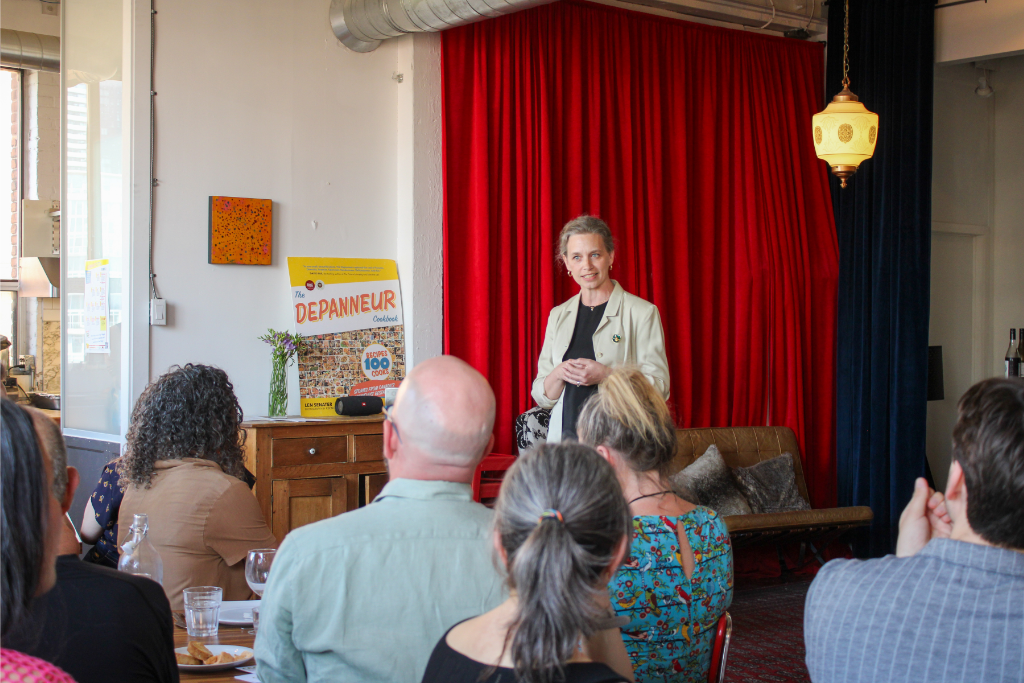
At the June 4 Taste the Difference event during Toronto Climate Week, Sarah Heynen introduces the Local Food Economy Regenerator—a new model for making local, regenerative food more accessible, visible, and valued.
Just a few weeks ago I was driving home from Ottawa after a weekend visit with my father. I was listening to a podcast – (The Emerald by Joshua Schrei, if any of you are familiar with it, and thank you Len). It was the episode “On singing to the beloved in Times of Crisis” and as the 2-hour episode was nearing its close, Josh said something that nearly threw me off the highway. Now before I jump to the punchline, I need to convey that among the most inspiring quotes I summon often are the words of Visionary Futurist, Buckminster Fuller “You never change things by fighting the existing reality. To change something, build a new model that makes the existing model obsolete.” So there I am, on the highway, and after a soulful tour through the world of myth, and these times in ways that Josh does so well – and after saying nothing about food - Josh asks…”Just what is this model, as Fuller talks of, that makes all other models obsolete.” And he says, “I don’t know, but I think it has something to do with food.”
And this is where we begin. What if the answer to everything that is broken is food?
And when I say broken, everyone here knows and feels what I mean, but it’s hard to talk about it because it isn’t just one thing. There’s a slew of crises these days – climate, water, biodiversity, affordability, housing. And then there are the non-material crises – loneliness, belonging, meaning.
It’s exhausting this crisis talk. So, for efficiency, society has birthed a label for these times: the Polycrisis.
And it all feels so overwhelming, until we allow ourselves to consider that all of today’s crises share a common root. A root anchored on an illusion – the illusion of disconnection.
Disconnection being the idea that anything can be separated from the larger whole.
And it shows up in all sorts of ways.
With nature – the idea that portions of it can be managed, controlled, manipulated, sprayed, extracted without impacting the larger web of life.
And in our communities, we feel the disconnect. The idea that some can gain while growing numbers of people suffer. We feel the weaking of our social fabric.
And I remember when it really struck me about the disconnect of our industrial food system – I learned from an industry insider about the category called “Belly stuffers”. These are ultra-processed foods designed with the cheapest inputs possible, to achieve the greatest sense of hunger relief at the lowest cost while delivering high margins. Totally disconnected from nourishment.
And this total disconnect defines our industrial food system - a cross-cutting, systems level problem. And the thing is, it’s working like it’s supposed to. That is because we have spent the last century optimizing it to achieve cheap, efficient mass production.
But in the process, there have been real costs. And those costs have been borne differently. Soil, farmers, independent businesses, workers, communities, and food itself. I’m not just talking about ultra-processed foods. Over the last 70 years, because of the impacts of industrial farming, fruits and vegetables have lost in some cases up to 80% of their nutrient density. I’m saying that, for example, we have to eat 10 times the amount of greens today than we would have eaten 50 years ago to get the same amount of iron. The extraction has been relentless. People are overfed but undernourished.
So imagine if our food system was optimized for a different end: Social Good. Where human health, ecological health and community wellbeing are the ultimate ends. This would be a system designed to better meet human needs – nutrition, of course, but also connection – to our communities, to the landscapes we call home, to the nature around us, and to the people who nourish us. And importantly, it would meet our need to know that we are on path to leave the planet better for future generations than how we found it.
So that optimization would mean putting us on a path of reconnection and regeneration.
That is a path that starts in the soil, and regenerating the web of life with care for the smallest of creatures. Because life begets life. Remember when we used to drive long distances and our windshields would be covered in bugs. I’d like to see those bugs come back. It would be a good sign. So we start in the soil, because living soil leads to the restoration of nature above ground too.
And living soil is also where taste begins. Flavour is a feedback mechanism to that tells our bodies there’s nutrients in that food.
So here’s the good news. We’re on this path right now. You’re about to enjoy a meal that proves it. Every farmer behind tonight’s ingredients is named on your menu. These are all farmers who pay close attention to the indicators that the web of life is being strengthened and restored through growing cycles.
Dave Kranenburg, whom you will hear from later, is the farmer entrepreneur whose business Graze ‘n Gather made it possible for these ingredients to be brought efficiently into the kitchen of Chef José Matamoros. We’re eating in a space designed by Len Senator, whose entire livelihood is dedicated to delivering experiences where food is valued as a social good, where plates are passed and dining is communal, where connections are fostered.
It feels good to eat this way. It tastes good. We want this. We have this.
But we find this at the margins. And why is that?
There are two big gaps: Infrastructure and Demand
So what does it look like to address those two gaps? Well, right now, we have a proposal before the city for work that would address these gaps. It’s called Flavour Harvest Spadina. And here’s what it looks like.
It looks like working, in relationship, with the communities of the Spadina corridor to deliver a market place campaign that joyfully welcomes community members into a
Flavour Harvest. Choosing hero foods, already part of the local supply chain, and overcoming the barriers facing the regenerative farmers of this region in getting those ingredients to market. And then featuring those hero foods, and the restaurants and businesses dedicated to their promotion. So it looks like building up the capacity of the Centre for Social Innovation to act as a drop off hub, with modest additions to cold storage capacity, and low-lift systems like ‘surplus ingredient notification systems’ so that local demand for these ingredients can be met. It looks like making community centres like the CSI places where group buying can happen, where bulk drop-offs make sense, and where market pop ups become a repeatable pattern.
Doesn’t this sound great? It’s through initiatives like these that we’re going to test and refine a new model, something that we are calling Local Food Economy Regenerators.
This is something we are building in collaboration, involving co-creators like:
Graze ‘n Gather and CSI
Societal Dynamics – or So-Dy – a historical policy lab
Zestyplan - a pioneer in technology supports to incentivize behaviour shifts and reward
through community
And there are others.
In fact, we hope there are people in this room right now, hearing about it for the first time that will want to be part of this.
The big idea is to build models like this across the country – starting right here in our bio-region, the Greater Tkaronto Bioregion.
And this is the perfect place to get started. With over 200 ethnic food traditions — food is already central to how communities identify and gather. We are surrounded by the globally significant greenbelt, the security of which we cannot take for granted.
There’s urgency. Thankfully, though, every aspect of this local food economy regenerator vision is already working from a running start – leaders like marketcityTO establishing a vision for a market in every ward, certifiers like Feast ON that reward restaurants for local sourcing, a community food ecosystem already serving hundreds of thousands of households annually, and independent food retailers like The Sweet Potato, Big Carrot, Karma Co-op and more that are neighbourhood fixtures. And, of course, 3 million kitchens and residents who already report high levels of motivation for thoughtful food choices.
We don’t think there is another city in North American with the same density of food-system assets available to people who are ready to re-connect to food.
So tonight is an invitation. First to savour the experience of what it means to value food as a social good. Moreso, to connect with us and be part of the Local Food Economy Regenerator. We are just getting started.